

As Bangladesh’s newly elected government prepares to announce its first national budget for 2026–27, education has emerged as a defining test of political intent. Will stated commitments translate into meaningful reform — or will the sector remain trapped in familiar cycles of underfunding, elite capture, and implementation gaps?
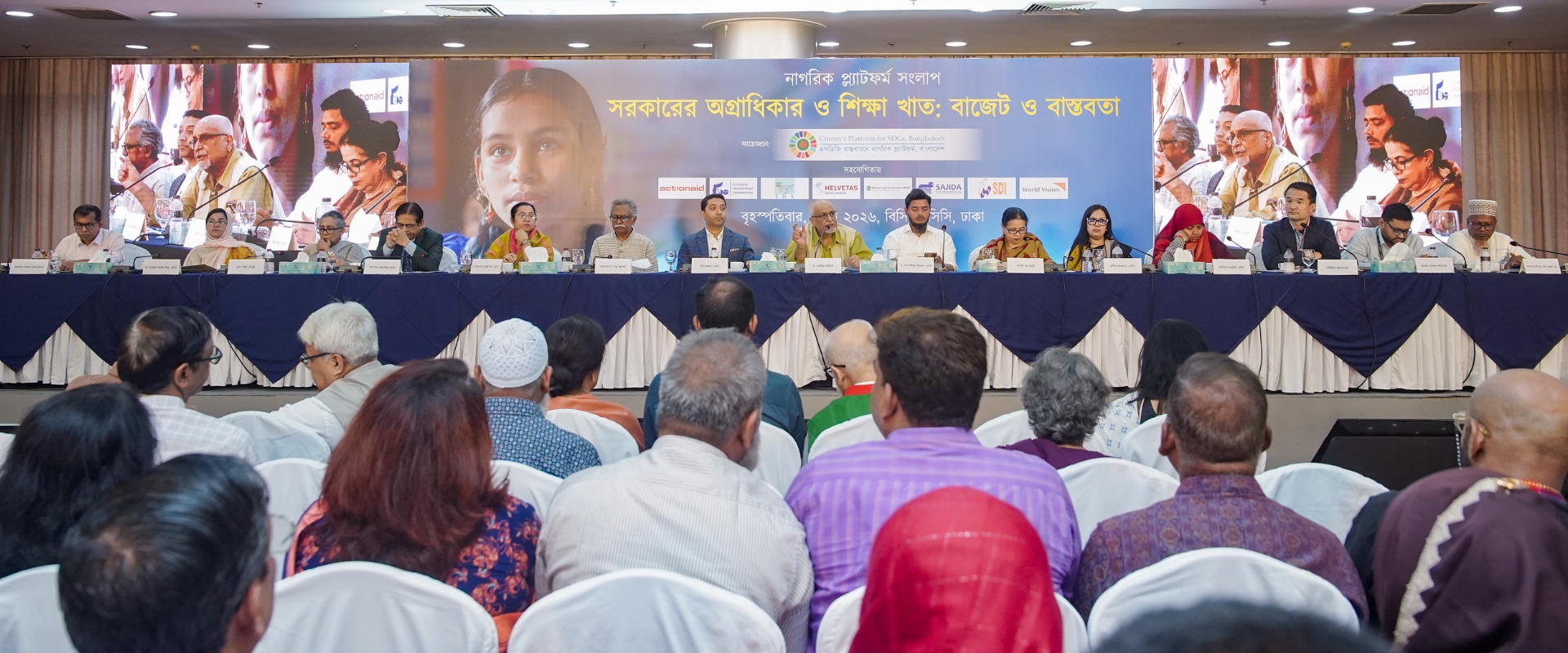
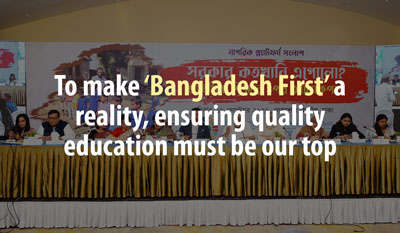
On 7 May 2026, the Citizen’s Platform for SDGs, Bangladesh brought together parliamentarians, education experts, civil society leaders, and international partners for a frank pre-budget dialogue: “Government Priorities in the Education Sector: Budget and Reality.” The conversation was as candid as it was urgent.
 The Numbers Tell a Troubling Story
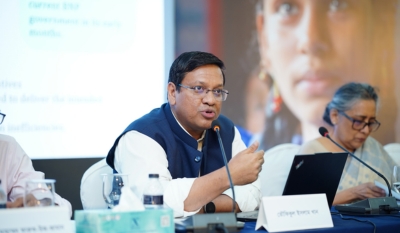
Bangladesh has made laudable strides in expanding access to education. But access is not the same as learning. Towfiqul Islam Khan, Additional Director at the Centre for Policy Dialogue (CPD), opened with a sobering reality check: despite repeated declarations of education as a national priority, public investment in the sector has been declining in relative terms.
The structural constraints are stark. Around 80–90% of education spending is consumed by salaries and operational costs — leaving little room to invest in quality, infrastructure, or innovation. Meanwhile, those who can afford to opt out of public education do so, weakening both accountability and the political incentive for systemic reform.
“Bangladesh must strengthen education financing both in scale and efficiency,” stressed Norihide Furukawa, Head of Education at UNESCO Bangladesh, pointing to learning outcomes that remain below international comparability standards and calling for stronger monitoring and evidence-based planning.
From Access to Excellence: A Movement, Not Just a Policy
Dr Debapriya Bhattacharya, Convenor of the Citizen’s Platform, framed the challenge in terms that went beyond budget lines. Bangladesh, he argued, needs not just a revised education policy but a renewed education movement — one that shifts the national conversation from enrolment figures to learning outcomes, from access to competency, from inputs to impact.
“Technical reforms must be supported by sustained political commitment and civic engagement,” he said. Without that broader coalition, even well-designed reforms risk stalling at implementation.
What the Room Said: Live Polling Reveals Where Consensus Lies — and Where It Doesn’t
One of the dialogue’s most revealing moments came not from the podium, but from the participants themselves. A live Mentimeter poll put five contested reform proposals to the room — drawing responses from up to 129 attendees. The results expose both a striking reform consensus and one genuinely unresolved debate.
On teacher preparation, the verdict was near-unanimous: 98% of respondents supported making pre-service training mandatory before teachers enter the profession. This is not a fringe position — it is a broad societal demand for professionalising teaching from the ground up.
Almost as decisive was the call for depoliticising school governance. 88% backed barring political office-holders from school management committees — a result that cuts across party lines and reflects deep frustration with how political patronage has distorted local education governance.
The appetite for regulatory reform extended to the private sector. 88% supported the creation of a national oversight institution to supervise educational institutions currently operating outside the national education board — signalling that the room sees fragmentation of the education system as a governance failure requiring structural remedy.
And on the question of whether the government should immediately establish an education reform commission, as promised in its own election manifesto, 93% said yes. That figure sends an unambiguous message: civil society is watching, and it expects the government to honour its word.
The one question that divided the room — almost evenly — was whether school examinations up to Class 5 should be abolished outright: 55 voted in favour, 57 against. This near-perfect split is itself instructive. It reflects a genuine tension between the pedagogical case for play-based, assessment-light early learning and legitimate concerns about classroom readiness, teacher capacity, and accountability in the absence of structured evaluation. Hon’ble State Minister for the Ministry of Primary and Mass Education Bobby Hajjaj, MP captured this ambivalence well, arguing that such reforms must be gradual and grounded in real improvements in classroom quality before they can be responsibly implemented.
Taken together, the polling reveals a reform-ready public — one that is impatient for governance change, broadly aligned on professional standards, and divided only where the evidence itself is genuinely contested.
What Reform Actually Requires
The dialogue’s substantive discussions reinforced what the polling suggested: the path forward requires structural shifts that go well beyond budget allocations.
Making teaching a profession, not a posting. Professor Anu Muhammad offered one of the dialogue’s sharpest critiques, arguing that decades of donor-dependent, project-driven reforms have weakened long-term policy coherence. He called for teaching to be treated as a respected full-time profession — with better pay, depoliticised recruitment, and training that prioritises inclusion and social sensitivity.
Financing that reflects ambition. Professor Mustafizur Rahman, Core Group Member of the Citizen’s Platform, noted that reaching the target of 5% of GDP for education would require significant budget restructuring and strong political will — and expressed scepticism about near-term feasibility. Yet he was clear: without it, inequality in educational access will continue to deepen inequality across society.
Outcome-based budgeting. Joint Secretary of the Ministry of Finance Muhammad Faruq-Uz-Zaman signalled a shift toward measuring what education spending actually delivers — in learning outcomes, employability, and skills — rather than simply tracking allocations.
Alternative financing. Aamer Mostaque Ahmed of the Youth Policy Forum proposed engaging international stakeholders and the private sector, including linking corporate actors in the RMG sector with nearby schools, and reducing taxes on digital devices to support learning access.
Voices Too Often Left Out
The dialogue made space for perspectives that rarely feature in budget discussions.
Rasheda K. Choudhury, Core Group Member and Executive Director of Campaign for Popular Education (CAMPE), pushed for continuous classroom-based assessment over exam-centric evaluation, better governance of private providers, and — critically — a permanent education commission to anchor reform beyond political cycles.
Professor Mia Muhammad Nurul Haq, Chairman of the Bangladesh Madrasa Education Board, called attention to persistent disparities facing madrasa students, whose access to quality learning and institutional support remains inequitable despite curriculum modernisation efforts.
Luva Nahid Choudhury of the Bengal Foundation made the case for education as a broader ecosystem — one that integrates arts, culture, and creativity into what it means to be educated in a modern economy.
And the open floor discussion surfaced what formal agendas often miss: the exclusion of students with disabilities, gaps in mid-day meal and “Smart School” implementation in remote areas, and the high cost of assistive technologies that leave the most vulnerable further behind.
Parliament Has a Role to Play
Four Members of Parliament offered pointed reflections on governance and reform, each bringing a distinct lens to the conversation.
Dr Mahmuda Alam Mitu, MP arguably offered the most expansive challenge to the room’s framing. Education reform, she argued, cannot be reduced to a sectoral policy conversation about investment and technology — it must be understood as part of a broader project of social and political transformation. Without addressing deep structural inequality, she warned, neither commissions nor curricula will deliver lasting change. She questioned the reflexive instinct to form yet another commission, suggesting that sustained engagement with systemic inequality may matter more than institutional architecture. Her critique extended to the classroom: teacher shortages, excessive administrative burdens placed on primary school teachers, and the often-overlooked problem of inadequately prepared trainers — the people tasked with improving teachers — all require urgent attention. And crucially, she insisted that any serious vision of education must make room for humanities, culture, and political culture-building, not just AI and digital skills.
Barrister Rumeen Farhana, MP echoed the concern about inequality, warning that Bangladesh’s deep structural disparities demand differentiated, context-sensitive solutions — not uniform policy responses. She called for education and healthcare to be treated as non-negotiable priorities, and stressed teacher dignity, fair remuneration, and depoliticised recruitment as preconditions for any meaningful reform.
Mardia Mumtaz, MP called for evidence-based policymaking over media-driven decisions and stronger standardisation across English-medium and religious education systems, alongside greater focus on classroom-level learning tools.
Nilufar Chowdhury Moni, MP was direct: “Reform must move beyond discussion towards implementation.” She highlighted teacher insecurity, coaching dependency, and inequality as key structural challenges, and called for sustained collaboration between government, citizens, and educators.
Their collective message to the government was unambiguous: stronger parliamentary oversight, genuine public consultation, and the courage to treat education as a civilisational priority — not a line item.
What Comes Next
The Citizen’s Platform’s ongoing Reform Tracker and Manifesto Watch will continue to monitor whether budget commitments translate into measurable progress — holding the government accountable against its own declared priorities.
The pre-budget dialogue made one thing clear: the question facing Bangladesh is not whether to invest more in education, but whether the political will, civic pressure, and institutional capacity exist to ensure that investment actually reaches the classroom. The room has spoken. Now it is the government’s turn.
Leave A Comment