

Following Bangladesh’s 13th National Parliamentary Election (held on 12 February 2026), the Bangladesh Nationalist Party (BNP)-led government assumed office. The newly elected government will face a complex economic landscape inherited from successive administrations. Drawing on its experience and research, the Citizen’s Platform for SDGs, Bangladesh has formulated a set of recommendations for the new administration, addressing prevailing challenges, key priorities and policy directions. These recommendations have been prepared with the intention of strengthening accountability and promoting greater transparency in the policy-making process.
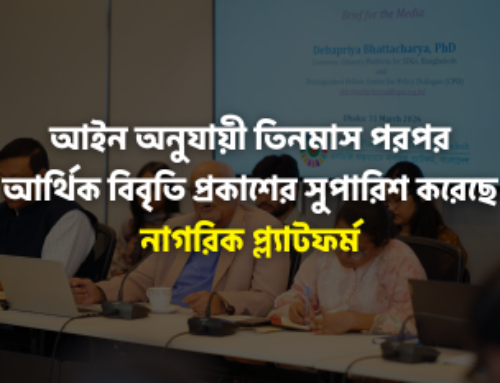
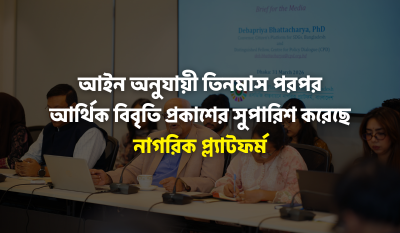
In this context, a media briefing titled Macroeconomic Benchmark for the New Government was organised by the Citizen’s Platform on 19 February 2026 to present its recommendations to the newly elected government.
Dr Debapriya Bhattacharya, Convenor, Citizen’s Platform and Distinguished Fellow, Centre for Policy Dialogue (CPD), moderated the briefing.
In his introductory remarks, he observed that the country is currently undergoing a transition, with the recent election marking a significant milestone in this process. As the new government assumes office, he underscored the importance of benchmarking the macroeconomy based on evidence and realism. From a Leave No One Behind (LNOB) perspective, he emphasised the need to clearly assess where the economy currently stands and to anticipate emerging trends in the period ahead. In the context of fragile economic stability, he cautioned that if the foundations of the economy are weak, the overall structure cannot remain sustainable. “Macroeconomic stability is the mother of all reforms,” he remarked.
Mr Towfiqul Islam Khan, Additional Director (Research), Centre for Policy Dialogue (CPD), delivered the keynote presentation. He highlighted the macroeconomic benchmarks and priorities for the new government. He emphasised that the government will assume responsibility and steer the economy through a challenging period. The structural constraints, including fragile macroeconomic stability, weakened private investment and diminishing fiscal space, require urgent policy attention by the new government to restore stability and ensure sustainable growth.
He also presented a series of policy recommendations to support macroeconomic stabilisation and fiscal discipline. While noting that the central bank intends to maintain the policy rate until inflation reaches a 7% benchmark, he suggested that a modest reduction might eventually be considered to signal support for private investment.
Additionally, Mr Khan suggested a gradual exchange rate depreciation and prioritisation of public expenditures to reduce wastage. He emphasised strengthening technical and legal efforts to recover stolen and defaulted assets, which could help restore economic confidence. He also stressed the importance of realistic budget planning, recommending that no further public funds be allocated for troubled financial institutions in FY2026 and that a frugal approach to operating expenditures be adopted for the remainder of the fiscal year. These measures are essential to strengthening macroeconomic fundamentals, restoring investor confidence and supporting long-term development objectives.
Mr Khan, along with Professor Mustafizur Rahman, Core Group Member, Citizen’s Platform and Distinguished Fellow, Centre for Policy Dialogue (CPD), responded to questions from the media, providing further insights and clarifications on the macroeconomic outlook and policy recommendations.
In his closing remarks, Dr Debapriya recommended the formation of a “transition team” to support informed policy-making. The team, comprising political representatives and policy experts, would conduct a transparent, systematic and forensic review of inherited financial commitments, debt obligations, contractual and policy decisions, and international agreements. It would prepare comprehensive briefing documents to enable objective evaluation of liabilities, risks and obligations, ensuring fiscal prudence, stability and sound decision-making. He emphasised the importance of clearly understanding domestic and external liabilities, contractual obligations and policy commitments to guide the incoming government effectively. Based on such assessments, he proposed publishing a “Blue Book” to guide policy direction and ensure transparency to the public.
He also emphasised the need to formulate a realistic revised national budget, establish a credible fiscal framework and pursue a coherent medium-term reform pathway. Stressing institutional capacity, policy coherence and accountability, he cautioned that without these measures, macroeconomic vulnerabilities could persist. He noted that, while the targets and goals of the new government are clear, questions remain about how they will be implemented. He added that the briefing had been organised to guide the path of economic reforms.

Leave A Comment